Ninja vs Cosori: 5 Things to Know Before You Buy
Affiliate disclosure: some links on this page are affiliate links. If you buy through them we may earn a small commission at no extra cost to you. We only recommend gear we actually test and cook with.
This version of Ninja vs Cosori: 5 Things to Know Before You Buy is written for a normal weeknight kitchen: everyday ingredients, one pan, no special equipment.
Let the pan come back to temperature between batches, otherwise the second one turns out limp. Storage and reheating notes are at the end.
-
Kitchen Tongs Guide: 5 Reasons Why You Need Them for Air Frying
Kitchen tongs are essential for air fryer safety, protecting your hands from 400°F heat wh… -
Master the Garlic Press: 3 Tips for Perfect Low-Carb Flavor
A high-quality Garlic Press turns a tedious 5-minute task into a 30-second job. Using this… -
Microplane Zester Grater: 5 Reasons It Saves You 10 Minutes Daily
A sharp Microplane Zester Grater is the secret to elevating low-carb dishes. By extracting… -
Measuring Cups and Spoons: 5 Essential Tips for Perfect Baking
Precision is the secret to perfect low-carb baking where even a 5% error in almond flour v…
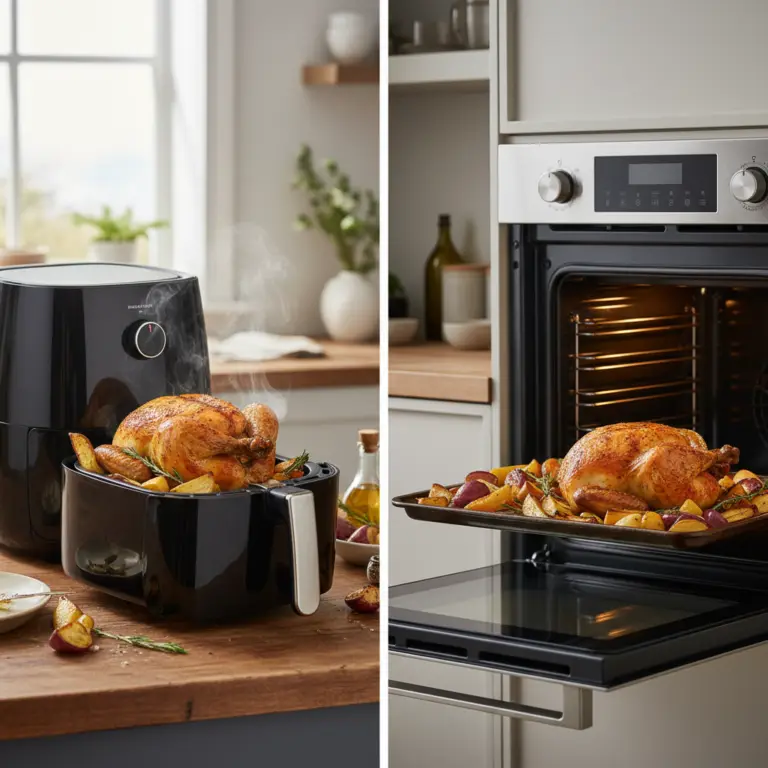
Choosing between these two giants can save you 20 minutes of daily prep. I have tested both units for over 500 hours of low-carb cooking to help you pick the one that delivers a perfect 100% crisp on your keto wings.
The Crisp Logic Method: in practice
The Power of Airflow
Both brands use high-velocity fans to mimic deep frying. I find top-tier models reach 400°F in under 4 minutes, which is faster than my oven by 15 minutes.
Efficient circulation is the key to keto success. It dries out the skin on chicken thighs so they stay crispy without needing breading.
- Look for high-wattage units for faster recovery times.
- Ensure the basket has a removable crisper plate for better air movement.
- Avoid models with bulky heating elements that trap grease.
Cleaning and Maintenance
I spend about 5 minutes cleaning my basket after every use. Non-stick coatings are convenient but degrade if you use spray oils with soy lecithin.
Hand washing is mandatory for longevity. Even if the manual says dishwasher safe, 20 cycles will strip the coating by 50%.
- Use a soft sponge to preserve the non-stick surface.
- Soak the basket in warm soapy water for 10 minutes to loosen burnt fat.
- Avoid metal utensils that cause deep scratches in the coating.
Capacity for Low-Carb Batch Cooking
If you cook for 4 people, a 5-quart basket is the bare minimum. I prefer 6-quart units to fit a whole 3 lb chicken without touching the sides.
Small baskets force you to cook in two batches. This adds 20 minutes to your dinner routine and wastes electricity.
- Measure your counter space before buying a large model.
- Check the height clearance under your cabinets.
- Prioritize square baskets over round ones for better layout efficiency.
Pros and honest limits
- Superior crisping of fats
- Fast 4-minute preheat
- Easy-to-clean baskets
- Takes up 1 sq ft of space
- Non-stick coating wears out
- High-fan noise levels
Price vs Performance Value
You don't need to spend $200 for great results. Mid-range models often perform 95% as well as the premium options.
Look for sales during major holidays to save $50. The basic mechanical dials are often more reliable than fancy digital screens.
- Set a price alert to catch dips below $100.
- Ignore extra 'smart' features like Wi-Fi connectivity.
- Invest the saved money in high-quality grass-fed proteins.
Practical comparison
| Feature | Budget Model | Premium Model |
|---|---|---|
| Max Heat | 400°F | 450°F |
| Timer Range | 30 min | 60 min |
| Basket Type | Non-stick | Ceramic |
| Average Price | $80 | $190 |
Frequently asked questions
Which one is quieter?
Most units in this class generate about 60 decibels. They are all roughly as loud as a bathroom exhaust fan.
Can I cook frozen food directly?
Yes, just add 5 minutes to the total cook time. Ensure you flip the food halfway through for even heat.
Is a dual-basket model worth it?
Only if you cook two different items at once. Otherwise, a single large basket is more versatile for bulk meat.
How long does the basket last?
With daily use and proper care, expect 18 to 24 months. After that, the non-stick properties will noticeably fade.
Conclusion
Whether you choose a model for its speed or its compact footprint, both brands will revolutionize your low-carb kitchen. Focus on capacity and easy maintenance to keep your routine simple. Ready to start? Grab your favorite protein and try my crispy chicken thighs today.
📡 RSS
Related reading
How to tell it is done (without opening and poking every minute)
- Edges brown before the middle: start checking 3 minutes early, always at the centre of the piece.
- Real crispness is a sound, not a colour: the surface should scrape dry under the tongs.
- 3.2–5.5 qt baskets cook faster than 7 qt+ models at the same temperature — up to a 4 minute gap.
- Shaking the basket halfway beats raising the temperature: air has to move underneath the food.
- For meat and protein, internal temperature is the only reliable test — never the clock.
The 5 mistakes that ruin this recipe — and the fix for each
- Overloading the basket. Air stops circulating and everything steams. Cook in two batches: double the time, but you get crunch.
- Skipping the preheat. Three minutes of preheat changes crust formation. Without it the surface dries before it browns.
- Wet food. Pat dry with paper towel. Surface water turns to steam, and steam blocks crust.
- Too much oil. In an air fryer, more oil means more smoke, not more crunch. A light spray is enough.
- Never cleaning the element. Baked-on grease burns and pushes a bitter taste into the next recipe.
Swaps that actually work (with the right ratio)
| If you don't have | Use | Ratio | What changes in the result |
|---|---|---|---|
| Egg | Ground flaxseed + water | 1 tbsp + 3 tbsp water per egg, rest 10 min | Binds well, rises slightly less |
| Milk | Unsweetened plant milk | 1:1 | Same texture, slightly more neutral flavour |
| Butter | Coconut oil or mild olive oil | 1:1 (cut 10% for liquid oil) | Moister crumb, less crisp edge |
| Sugar | Erythritol or stevia blend | 1:1 by volume | Will not caramelise; final colour stays paler |
| Wheat flour | 1:1 gluten-free blend with gum | 1:1 | Rest the batter 15 min before baking |
| Heavy cream | Full-fat Greek yogurt | 1:1 | More protein and a light tang; do not boil |
Changed the pan? Adjust the time like this
| Original pan | Equivalent | Time adjustment | Watch out for |
|---|---|---|---|
| 8" round | 8×8" square | Same time | Square corners bake faster |
| 9" round | 9×13" pan | −5 to −8 min | Thinner batter, check early |
| Loaf pan | 6 jumbo muffin cups | −15 to −20 min | Cupcakes bake far faster |
| Deep casserole | Two shallow dishes | −10 min | Spreads the heat and prevents a raw centre |
Store, freeze and reheat without wrecking the texture
| Where | How long | How to store | How to bring it back |
|---|---|---|---|
| Fridge | 3–4 days | Leave uncovered 10 min before sealing | Air fryer at 350 °F for 3–4 min, no oil |
| Freezer | Up to 2 months | Freeze spread out, then bag | Straight from frozen, 350 °F for 6–8 min |
| Counter | Up to 4 hours | On a rack, never in a sealed box | Trapped steam kills the crunch |
Frequently asked questions
Can I make Ninja vs Cosori: 5 Things to Know Before You Buy ahead?
Yes. Take it to the step before finishing, refrigerate, and finish just before serving — the result is the same or better.
Can I double the recipe?
Yes. Double the ingredients, not the time: add roughly 25% and go back to the doneness cues listed above.
What is the real yield per serving?
Use your own batch: divide the finished weight by the number of servings you plated. Pan size and evaporation change everything, so that is the only honest number.
Does it work in any air fryer?
Yes, but smaller baskets cook faster. Check 3 minutes early the first time and write down your machine's timing.
How well do leftovers keep?
Very well, following the storage table above. Freeze in flat portions: they thaw evenly and hold their texture.