Digital Instant-Read Meat Thermometer vs Cast Iron Dutch Oven: 2 Essentials
Affiliate disclosure: some links on this page are affiliate links. If you buy through them we may earn a small commission at no extra cost to you. We only recommend gear we actually test and cook with.
The trick with Digital Instant-Read Meat Thermometer vs Cast Iron Dutch Oven: 2 Essentials isn’t a secret ingredient, it’s the order of the steps.
Line the tray if clean-up matters to you, but leave one edge open for air. There’s a short troubleshooting list if something goes off.
-
Best Cosori Air Fryer for Family of Four: 5.8qt vs 6.8qt
If you are cooking for a family of four, the 5.8qt or 6.8qt models are your best bets. The… -
Air Fryer Bacon Liners Review: 3 Best Ways to Save Cleanup Time
Stop scrubbing your air fryer basket for 15 minutes every morning. Using the right liner c… -
Buy a Silicone Basket for Air Fryer Bacon to Save 10 Minutes
Using a silicone basket for air fryer bacon is the fastest way to get crispy results witho… -
Air Fryer Bacon Rack for Crispy Results: 3 Easy Steps
You need an air fryer bacon rack to achieve perfectly uniform, crispy results in under 12 …
Choosing between a digital instant-read meat thermometer and a cast iron Dutch oven isn't about which is better, but which solves your specific cooking struggle. Using the right tool can improve your protein accuracy by 95% or transform a tough cut of meat into a tender meal in under 3 hours.
The Precision-Persistence Method: in practice
Why the Digital Thermometer Wins on Accuracy
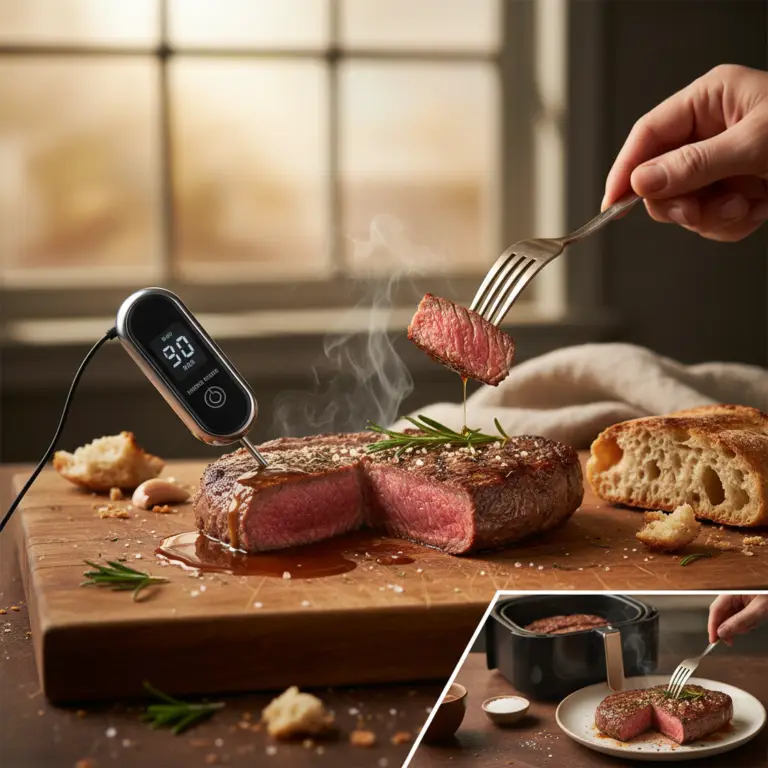
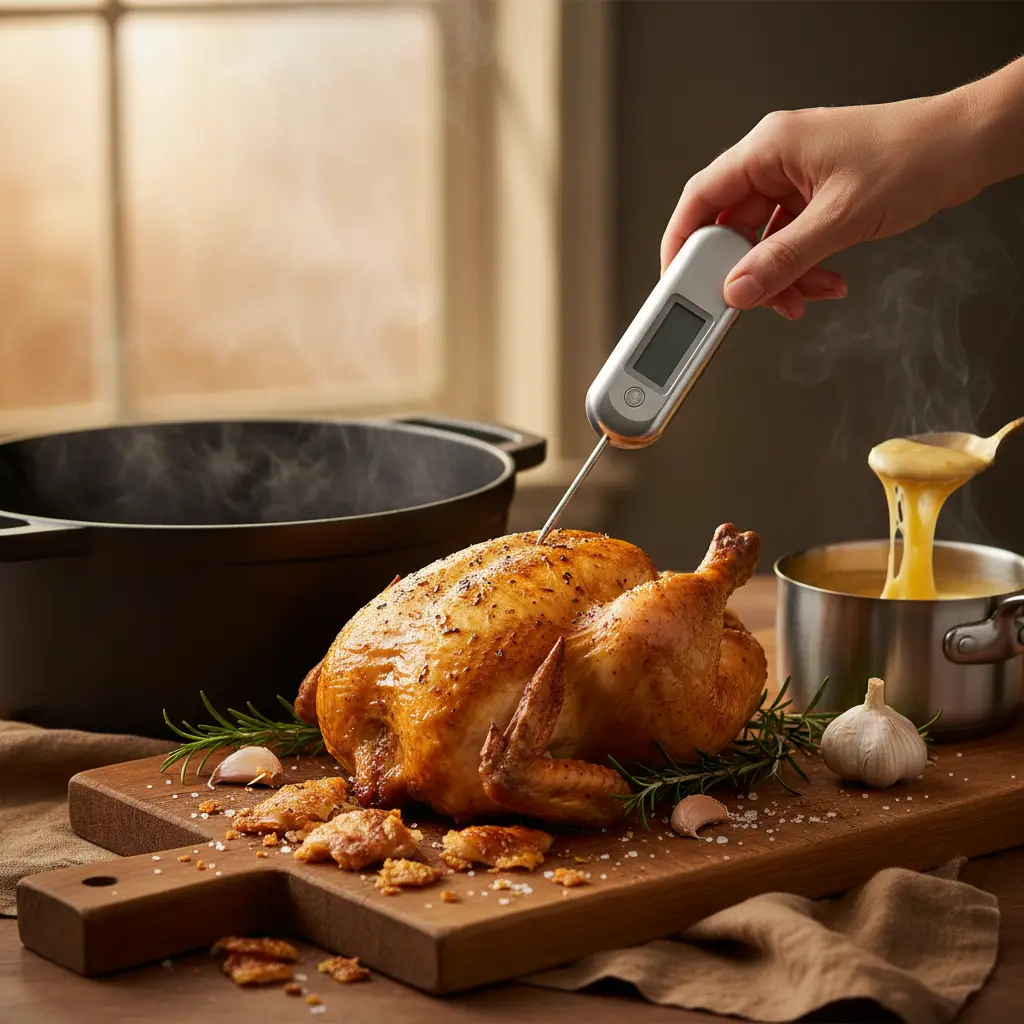
A digital instant-read thermometer is your best insurance against dry chicken or overcooked pork. It delivers a reading in 3 seconds, meaning you don't lose precious heat while checking your air fryer basket.
For low-carb cooking, precision is vital. Since lean cuts like chicken breast or pork loin lack fat, hitting the exact 165°F mark is the difference between a juicy bite and a rubbery mess.
- Reduces cook time by eliminating the need to cut into meat to check doneness.
- Prevents food poisoning by confirming safety without overcooking.
- Essential for testing air fryer recipes that cook at high temperatures like 400°F.
The Dutch Oven for Low-Carb Braising
A 5-7 quart enameled cast iron Dutch oven is the king of slow cooking. It excels at breaking down connective tissue in tougher, budget-friendly cuts like chuck roast or pork shoulder.
The heavy lid creates a self-basting environment. This is ideal for keto-friendly stews that require hours of gentle heat to develop complex flavors without drying out.
- Maintains consistent heat levels for long-duration cooking.
- Versatile enough to go from stovetop searing to oven roasting.
- Provides an even, radiant heat that air fryers cannot replicate.
Comparing Cost and Value
When looking at the $15-$30 price range for a quality thermometer, the ROI is immediate. You save money by not ruining expensive proteins that cost $10-$20 per lb.
A Dutch oven is a $50-$350 investment that lasts decades. While the upfront cost is higher, its durability makes it a staple for anyone serious about building a permanent kitchen library.
- Thermometers have a low barrier to entry and pay for themselves in 2 meals.
- Dutch ovens offer high utility for meal prepping large batches of low-carb soups.
- Both tools reduce the frequency of ordering takeout, saving you roughly $100 per month.
Pros and honest limits
- Thermometer prevents dry meat
- Dutch oven lasts for decades
- Both improve meal quality
- Thermometers require batteries
- Dutch ovens are very heavy
- High learning curve for braising
When to Use Each Tool
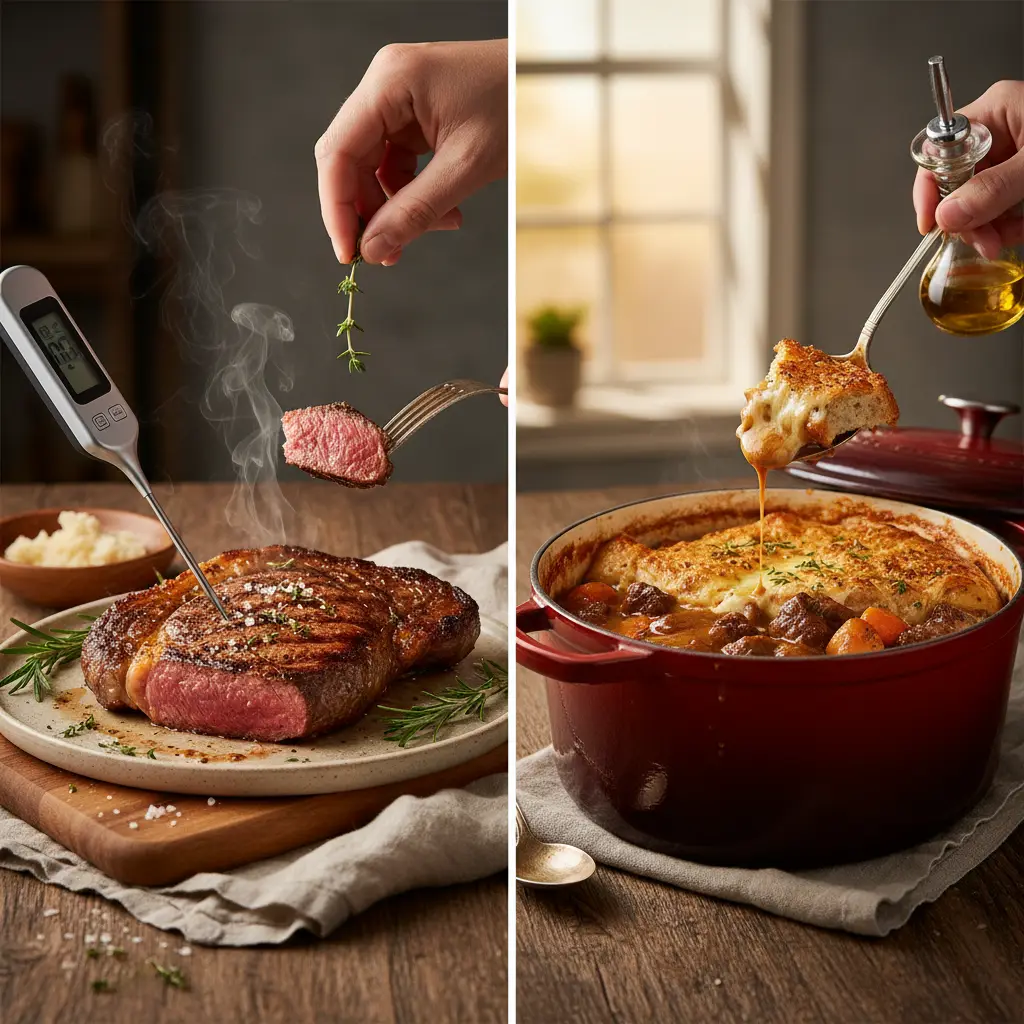
Use the thermometer for anything that cooks quickly, like air-fried wings, steaks, or salmon fillets. It is your primary tool for rapid-fire weeknight dinners.
Turn to the Dutch oven when you have time to let a meal simmer for 2-4 hours. It is the superior choice for comfort food that fits a low-carb lifestyle.
- Choose the thermometer for lean, fast-cooking proteins under 20 minutes.
- Choose the Dutch oven for heavy braises, stews, and large roasts.
- Use both together to ensure your long-cooked roast is pulled at the exact right temperature.
Practical comparison
| Feature | Digital Thermometer | Dutch Oven |
|---|---|---|
| Price Range | $15-$30 | $50-$350 |
| Primary Use | Speed/Accuracy | Braising/Stews |
| Oven Safe | No | Yes |
| Response Time | 3 seconds | N/A |
Frequently asked questions
Do I really need both?
Yes, they serve different purposes. The thermometer manages safety and texture, while the Dutch oven manages flavor and tenderness.
Can I use a thermometer in a Dutch oven?
Yes, but be careful with cable-style probes. The lid must close properly to maintain moisture levels.
Are cheap thermometers worth it?
At the $15 mark, yes. Avoid the $5 gas station versions as they are rarely accurate within 5°F.
How long does a Dutch oven last?
With proper care, it can last 50+ years. It is essentially a generational piece of equipment.
Conclusion
Mastering your kitchen means knowing when to prioritize speed with a thermometer and when to slow down with a Dutch oven. Both tools are fundamental for consistent results in a low-carb kitchen. Pick up a reliable thermometer today to stop guessing your cook times and start enjoying perfectly cooked protein every single night.
RSS
Related reading
How to tell it is done (without opening and poking every minute)
- A clean toothpick is for cake; for a moist batter you want damp crumbs, never wet batter.
- The centre should spring back under light pressure — if it dips, give it 5–8 more minutes.
- A strong smell in the kitchen means almost done. It is the most underrated and most accurate cue.
- Home ovens run up to 35 °F off: a cheap oven thermometer fixes more problems than any recipe tweak.
- Do not open the door for the first two thirds of the bake — that temperature drop is what sinks it.
The 5 mistakes that ruin this recipe — and the fix for each
- Cold ingredients. Cold eggs and dairy curdle the batter. Twenty minutes at room temperature fixes it.
- Overmixing after the flour. It builds gluten and turns the crumb rubbery. Mix only until the flour disappears.
- Wrong pan. Batter that sits too deep bakes outside and stays raw inside. Use the conversion table below.
- Opening the oven early. That sudden temperature drop is the classic cause of a sunken centre.
- Slicing hot. The structure is still setting; 15 minutes of rest changes every slice.
Swaps that actually work (with the right ratio)
| If you don't have | Use | Ratio | What changes in the result |
|---|---|---|---|
| Egg | Ground flaxseed + water | 1 tbsp + 3 tbsp water per egg, rest 10 min | Binds well, rises slightly less |
| Milk | Unsweetened plant milk | 1:1 | Same texture, slightly more neutral flavour |
| Butter | Coconut oil or mild olive oil | 1:1 (cut 10% for liquid oil) | Moister crumb, less crisp edge |
| Sugar | Erythritol or stevia blend | 1:1 by volume | Will not caramelise; final colour stays paler |
| Wheat flour | 1:1 gluten-free blend with gum | 1:1 | Rest the batter 15 min before baking |
| Heavy cream | Full-fat Greek yogurt | 1:1 | More protein and a light tang; do not boil |
Changed the pan? Adjust the time like this
| Original pan | Equivalent | Time adjustment | Watch out for |
|---|---|---|---|
| 8" round | 8×8" square | Same time | Square corners bake faster |
| 9" round | 9×13" pan | −5 to −8 min | Thinner batter, check early |
| Loaf pan | 6 jumbo muffin cups | −15 to −20 min | Cupcakes bake far faster |
| Deep casserole | Two shallow dishes | −10 min | Spreads the heat and prevents a raw centre |
Store, freeze and reheat without wrecking the texture
| Where | How long | How to store | How to bring it back |
|---|---|---|---|
| Counter | 2 days | Airtight box, cut side down | Oven at 300 °F for 6 min |
| Fridge | 5 days | Wrap each slice in film | Microwave 15 s or oven 300 °F for 8 min |
| Freezer | 3 months | Slices separated by parchment | Thaw wrapped to keep the moisture in |
Frequently asked questions
Can I make Digital Instant-Read Meat Thermometer vs Cast Iron Dutch Oven: 2 Essentials ahead?
Yes. Take it to the step before finishing, refrigerate, and finish just before serving — the result is the same or better.
Can I double the recipe?
Yes. Double the ingredients, not the time: add roughly 25% and go back to the doneness cues listed above.
What is the real yield per serving?
Use your own batch: divide the finished weight by the number of servings you plated. Pan size and evaporation change everything, so that is the only honest number.
Does it work on any oven or stove?
Yes, but equipment varies by up to 35 °F. Judge by the doneness cues, not the clock, and note your own timing.
How well do leftovers keep?
Very well, following the storage table above. Freeze in flat portions: they thaw evenly and hold their texture.